Where the Offcut Goes: Building a Circular Record for UK Metal Fabrication
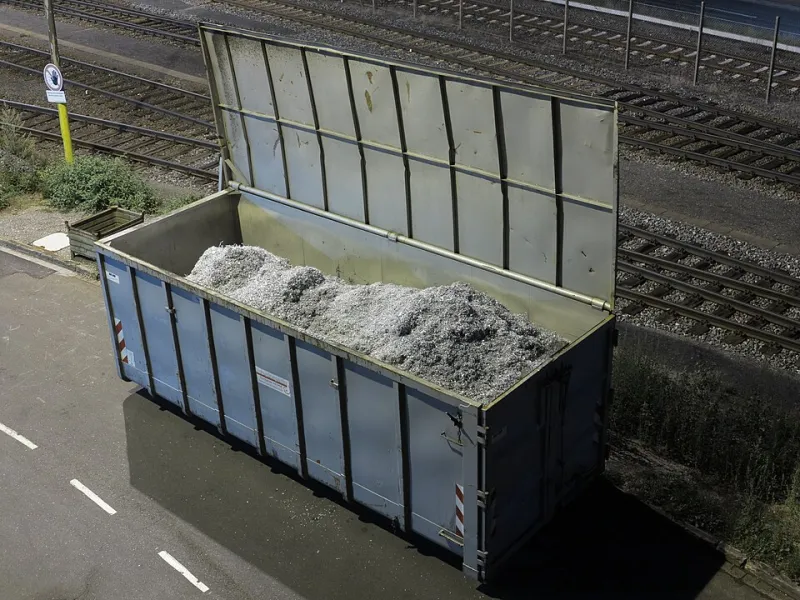
Photo: TeWeBs, CC BY-SA 4.0, via Wikimedia Commons
In most UK fabrication businesses, the skip is the cheapest thing on the premises to ignore. It is hired, filled, swapped and invoiced with little comment. Yet the material that leaves a workshop in that skip, and in the swarf bins beside it, represents both a recoverable revenue stream and an environmental claim that clients are increasingly asking fabricators to substantiate. The gap between what the sector says about circularity and what it can actually evidence is wide, and it is closing from the procurement side.
What Genuinely Leaves the Floor
The first discipline is nomenclature. Offcuts are not all scrap. A clean 1200 by 800 millimetre remnant of 10 millimetre mild steel plate has a use; a bent, rusty, part-consumed strip does not. Workshops that treat both identically are effectively donating usable stock to the merchant.
Beyond that, the streams divide predictably: turnings and millings from machining, often wet with coolant; dross from laser and plasma cutting; spent abrasives and cut-off wheels; filter media and extraction dust from welding fume systems; packaging steel banding; and the occasional end-of-life fabrication returned by a client, which is the only stream that can meaningfully be called circular rather than merely recycled.
Segregate Where the Material Is Made, Not at the End of the Shift
Contamination is the enemy of value. A stainless offcut that has shared a bin with mild steel will be downgraded at the weighbridge, and no amount of argument at the gate will recover the difference. Segregation has to happen at the point of generation, which means labelled, colour-coded containers at each cutting table and forming cell, sized so that filling them is not an inconvenience.
The essential separations in a typical UK shop are mild steel, 304 and 316 stainless, aluminium, and copper-bearing alloys. Stainless deserves particular attention: mixing 304 with 316 is a value loss, and any stainless that has picked up carbon steel contamination from a shared bandsaw or floor is compromised as a feedstock. Swarf should be kept as dry as practicable, and coolant recovered where a briquetting press is in use rather than left to soak into the load.
Density Is Money
Scrap merchants buy weight and sell density. Loose turnings occupy volume that costs money to transport, and the price offered reflects it. Baling sheet offcuts and briquetting swarf both increase the payload per load and, in most cases, the rate per tonne. A baler is not a trivial purchase, but a workshop producing several tonnes a month of light material will usually find the payback legible within a reasonable period, and the floor space recovered from overflowing bins is a further gain that rarely appears in the calculation.
Selling Scrap Without Losing Traceability
Here the circular ambition meets an awkward fact. A fabrication built to EN 1090 execution class requirements, or carrying mill certificates for a pressure application, is traceable through its heat numbers and inspection records. Once it is cut up and baled, that traceability ends. The material re-enters the market as unidentified scrap.
That is unavoidable, but the documentation should not vanish with it. Good practice is a scrap disposition log that records, for each consignment, the material grades included, the heat numbers or certificate references where relevant, the weight, the date, the receiving merchant and the waste transfer note reference. Duty of care obligations under the Environmental Agency regime require transfer notes to be retained for two years, and that period is a floor rather than a target. Keeping records for five years costs little and answers questions that arise long after the bin has gone.
Designing Joints That Can Be Undone
Circularity is decided at the drawing board far more than at the weighbridge. A fully welded assembly is, in practice, a permanent object; separating its constituent materials at end of life requires cutting, and the recovered value rarely justifies the labour. Where the design allows, mechanical fastening at material interfaces, accessible fixings, and consistent marking of alloy types make later dismantling viable.
This is not a recommendation to compromise structural integrity for recyclability, and no responsible fabricator would treat it as such. It is a matter of noticing where a bolted connection would do the same job as a weld, and where a design decision made for disassembly also happens to make maintenance easier, which is often the more persuasive argument to a client.
Claims That Withstand Examination
Sustainability language in UK tenders has become more specific and less forgiving. Statements such as '100 per cent recycled' applied loosely to a steel fabrication will not survive a competent question, because recycled content and recyclability are different properties and neither is a property of the finished welded assembly in the way the phrasing implies.
Credible claims tend to share three characteristics: they are narrow, they are measured, and they are bounded in time. 'In the twelve months to March 2026, 96 per cent by weight of metallic waste leaving this site was segregated by grade and sold to a licensed merchant' is a defensible sentence. 'Committed to a circular future' is not. The first can be audited; the second cannot be checked at all, and buyers have learned to discount it accordingly.
Calculating a Waste-Cost Baseline
The starting point for any improvement programme is an honest number, and most workshops do not have one. A workable baseline per job, or per month, is built from four components:
- Material lost: the cost of stock purchased that leaves as waste, not merely the rebate received for it.
- Handling labour: the time spent sorting, moving and loading, which is real and rarely recorded.
- Storage and floor space: the value of the area occupied by bins and skips over a year.
- Waste contractor charges, net of any scrap rebate.
Expressed as a percentage of material spend, the figure is usually larger than expected. A shop buying four hundred thousand pounds of steel a year and returning sixty thousand pounds in rebates, while spending thirty thousand on skips and thirty hours a month on handling, is looking at a net waste cost that dwarfs the rebate line it has been tracking.
That single calculation tends to do more for circular practice than any policy statement, because it converts an environmental argument into a commercial one. Once the number is visible, segregation bins get funded, the baler gets approved, and the merchant conversation gets sharper. The environmental record improves as a consequence rather than as a gesture, which is the only way it lasts.