When Steel Runs Colder Than Air: A Winter Welding and Coating Regime
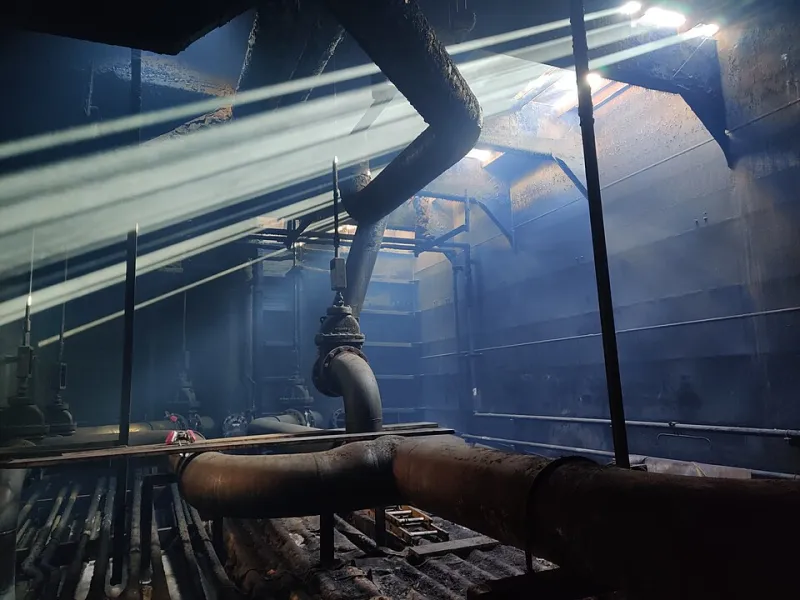
Photo: GuavaTrain, CC BY-SA 4.0, via Wikimedia Commons
In late November a steel frame at seven in the morning is frequently colder than the air moving past it. That single fact, more than the calendar or the forecast, decides whether the day's welding and coating will still be sound in five years. Cold weather does not announce itself with frost; it arrives as a two-degree gap between surface and dew point, a draught across an open-sided structure, and a crew that has been told to crack on.
What follows is a regime rather than a lecture: the checks that belong in a daily briefing, the numbers that belong on a record, and the assumptions that most often turn into a defect.
The gap that matters more than the temperature
Air temperature is the number everyone quotes and the number that matters least. Protective coatings and welded joints respond to the temperature of the substrate, and in a British winter the substrate can sit several degrees below ambient after a clear night, particularly on shaded elevations and on steel that has been stored outside.
The working rule is familiar: the surface must be at least 3°C above dew point before abrasive blasting, before coating, and again before each subsequent coat. During welding, the concern shifts to condensation inside the joint preparation and to the rate at which heat is conducted away from the arc.
A handheld hygrometer and a magnetic contact thermometer cost little and settle the argument in seconds. The discipline is to use them at the surface, in the position, at the time — not at the site hut door at nine o'clock.
Five hold points for the morning briefing
A winter regime does not need a long list. It needs a short one that is genuinely enforced:
- Substrate temperature against dew point before blasting begins, recorded at two or three representative locations.
- Preheat verification immediately before the first arc, measured at the specified distance from the joint rather than at the cap.
- Interpass temperature on multi-run work, where a cold plate can pull the weld below the permitted minimum between passes as readily as a hot one can push it above the maximum.
- Ambient conditions — air temperature, relative humidity and steel temperature — before the first coat and before each subsequent coat.
- Cure check before handling, stacking or overcoating, because a coating that has skinned in cold air has not necessarily cured.
Each of these is a pause of under a minute. The cost of skipping one is measured in weeks.
Preheat is not a thermostat setting
Specifying a preheat temperature is straightforward; achieving it on a cold, exposed frame is not. Heat introduced at the joint is conducted into the surrounding plate, and the colder that plate is, the faster the joint returns below the required minimum. On heavier sections this means soaking, not waving: ceramic pads or induction where the geometry allows, and a check that the temperature is uniform across the joint rather than concentrated at one point.
Where a procedure requires a specific preheat, the reading should be taken with the same instrument and at the same offset throughout the job, and the instrument identified on the record. Two technicians with two different contact thermometers will produce two different numbers, and the argument that follows is always more expensive than the calibration.
Shelter, draught and the gas that blows away
Wind is the quiet saboteur of winter work. Shielding gas disperses, arc stability suffers, and a welder compensating with a longer stick-out or a higher current introduces defects that no amount of later inspection will trace back to the weather.
Simple windbreaks and framed shelters solve most of this, provided they are erected before the work starts rather than after the first reject. Two trade-offs need managing.
Ventilation. A heated shelter that is buttoned up against the weather will also trap fume, solvent vapour and carbon monoxide from fuel-burning heaters. Extraction and air changes belong in the same plan as the sheeting.
Power and gas supply. Long extension runs on cold cable produce voltage drop, and voltage drop produces welds that look acceptable and behave badly. Gas hoses stiffen and regulators can behave unpredictably in low temperatures; both are worth a morning check rather than a mid-afternoon diagnosis.
Where 'warm enough to touch' becomes an expensive defect
Consider a bright, still morning in February: air at 4°C, relative humidity around 75%, steel at 1°C. To a gloved hand the steel feels perfectly dry. To a hygrometer, the dew point is close to 3°C — the surface is below it, and a film of moisture is forming on the blasted profile faster than the eye can register.
Coat applied to that surface will adhere well enough to pass a thumb test and fail within a season. Blisters, or delamination along the blast profile, will appear where the moisture was trapped, and the investigation will start with the coating supplier and work backwards to a morning nobody wrote down.
The same logic applies to welding. A joint that has been left open overnight can hold condensation in the root gap long after the surface appears dry, and hydrogen has a particular appetite for cold, hard, fast-cooled weld metal.
Recording without slowing the crew
Documentation fails when it competes with production. A single pre-printed shift card, one row per hold point, completed by the person who took the reading, is enough. Add a timestamped photograph of the instrument display against the work and the record is effectively self-policing; a photo of a gauge on a plate carries its own evidence of time, place and value.
Store the cards with the inspection and test plan rather than in a separate file. When a client asks in eighteen months why a particular elevation was coated on a particular day, the answer should take thirty seconds to find.
Closing the day before the temperature falls
The end of a winter shift deserves its own check. Open joints protected, blasted steel not left bare overnight, heaters off and ventilation maintained, and a note of any surface that will be below dew point by morning. Cold weather work is not harder than warm weather work; it simply rewards preparation at the start of the day and honesty at the end of it.