Specification to Sign-Off: Commissioning Bespoke Metalwork with Fewer Surprises
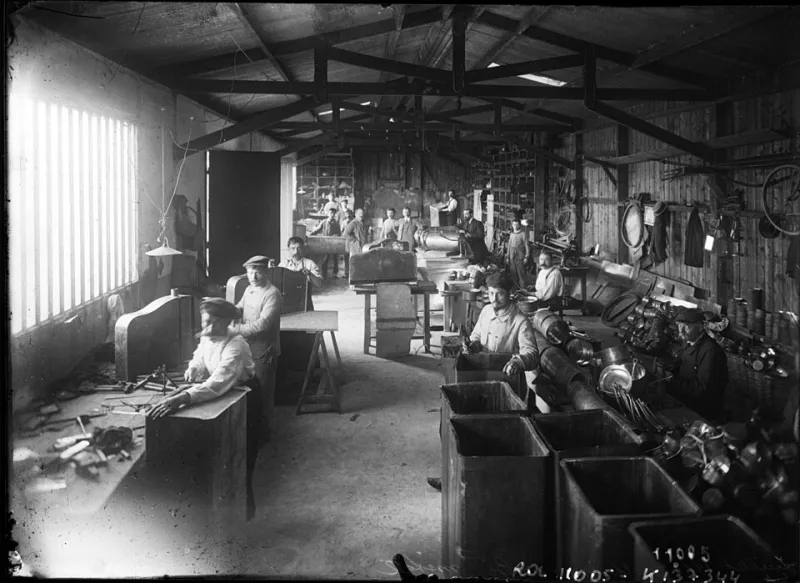
Photo: Agence Rol. Agence photographique (commanditaire), Public domain, via Wikimedia Commons
Commissioning bespoke metalwork should be a controlled engineering process, not a hopeful purchase order. Whether the requirement is a machine frame, access platform, structural steel assembly, enclosure or one-off fabrications, the quality of the outcome is usually decided before the first cut is made. This guide sets out a practical UK workflow for moving from a concept or drawing board to a factory floor and, ultimately, to a documented sign-off.
1. Define the duty, not just the drawing
Start with what the fabricated item must do. A drawing may show geometry, but it seldom captures the full duty: loadings, vibration, thermal movement, access requirements, surface finish expectations, cleaning regimes and the interface with existing equipment. Write these down. A supplier cannot price risk it cannot see.
For UK projects, it also helps to state the intended environment. An internal machine guard, an external walkway and a coastal installation have very different corrosion and maintenance demands. Clarifying the duty early prevents a later argument about whether a specification was adequate.
2. Set tolerances that match function
Tolerances are not a test of supplier skill; they are a statement of what the design actually needs. Over-tight tolerances add cost and inspection burden without improving function. Under-tight tolerances create assembly problems and rework.
Review critical dimensions, datum references, hole positions, flatness, squareness and weld distortion allowances. Where a tolerance is important, explain why. Where it is not, allow a sensible general tolerance to apply. A good fabrication supplier will welcome this conversation and may propose a more economical detail that preserves the design intent.
3. Specify materials and traceability
Material specification should include grade, form, thickness, surface condition and any certification requirement. For structural work, the material grade and traceability expectations should be explicit. For machined or laser-cut parts, consider whether mill certificate traceability is required or whether a standard commercial grade is sufficient.
Avoid vague descriptions such as mild steel or stainless without grade. Also clarify acceptable alternatives and who approves substitutions. If material certificates are required, state the format and when they must be supplied. Traceability is much easier to manage before purchase than after delivery.
4. Confirm BS EN 1090 and welding requirements
For structural steel fabrication in the UK, BS EN 1090 is the reference point. The client should establish the execution class required for the work and confirm that the supplier can work to it. This is not a box-ticking exercise. It affects welding procedures, welder qualification, inspection, documentation and the supplier's factory production control.
Even for non-structural fabrication, welding quality still matters. State the welding standard or acceptance criteria, whether visual inspection is sufficient, and whether non-destructive testing is required. If NDT is needed, agree who arranges it, who pays for it and what happens if discontinuities are found.
5. Agree inspection and documentation
Inspection should be planned before production begins. A typical routine includes material verification, in-process dimensional checks, weld inspection, final dimensional inspection and surface treatment checks. For repeat work, a first-article inspection may be appropriate. For one-off assemblies, a hold point before finishing can prevent expensive rework.
Ask what records will be supplied: inspection reports, material certificates, welder qualifications, NDT reports, photographs and surface treatment certificates. Agree the format and timing. Documentation that arrives weeks after delivery is far less useful than documentation issued with the job.
6. Plan logistics and site interface
Bespoke fabrication often fails at the boundary between factory and site. Confirm lifting points, transport limits, access restrictions, delivery windows and unloading responsibility. For larger assemblies, consider whether trial assembly at the works is required before dispatch.
Clarify who checks the goods on arrival and how damage or shortages will be recorded. If the item is to be installed by others, agree the interface dimensions and the tolerances that matter for installation. A fabrication that is correct in the workshop but cannot be manoeuvred into position is still a problem.
7. Use a pre-award checklist
A simple checklist reduces avoidable ambiguity. Adapt the following to the project:
- Duty and environment clearly stated
- Drawing revision and status confirmed
- Critical tolerances identified and justified
- Material grades and traceability requirements specified
- BS EN 1090 execution class confirmed where applicable
- Welding standard and NDT requirements agreed
- Inspection hold points and documentation defined
- Surface treatment specification and warranty confirmed
- Delivery, lifting and unloading responsibilities agreed
- Change control process documented
- Commercial terms and payment milestones reviewed
Red flags that suggest corner-cutting
Be cautious if a supplier will not discuss tolerances and simply says it will work to the drawing. Be cautious if material certificates are promised vaguely or only after repeated requests. A quotation that is dramatically cheaper than others may be excluding inspection, traceability, proper surface treatment or realistic transport.
Other warning signs include unclear welding qualifications, no identifiable inspection routine, reluctance to provide a named contact for technical queries, and a willingness to accept every change without recording cost or schedule impact. Good fabricators are not necessarily the ones who say yes to everything. They are the ones who ask precise questions and document the answers.
Sign-off is a process, not a signature
The most reliable bespoke fabrication projects are those where specification, inspection and logistics are treated as part of the engineering scope. By defining the duty, setting sensible tolerances, confirming compliance requirements and agreeing evidence early, UK buyers can reduce risk without squeezing the supplier into unsafe shortcuts. The result is a cleaner route from drawing board to factory floor, and a sign-off that reflects the job that was actually specified.